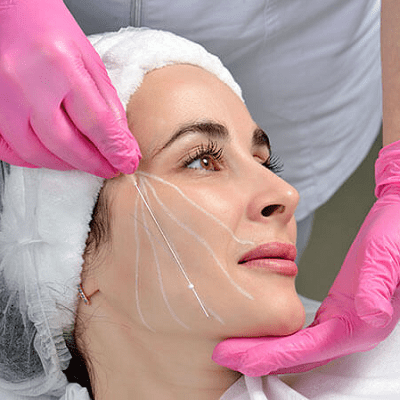
Are you noticing mild sagging around your cheeks, jawline, or lower face but aren’t ready for traditional facelift surgery? A thread lift may offer a minimally invasive option for selected patients who want a subtle lifting and contouring effect with less downtime. Understanding Thread Lift: Benefits, Procedure, Recovery, and Results can help you decide whether this treatment matches your aesthetic goals and expectations.
A Thread Lift uses specialized absorbable sutures placed beneath the skin to provide mechanical support and stimulate a healing response that can contribute to collagen production. The treatment is generally performed under local anesthesia and does not involve the larger incisions associated with a surgical facelift.
What Is a Thread Lift?
A thread lift is a minimally invasive facial rejuvenation procedure designed to improve the appearance of mild to moderate skin laxity. Depending on the treatment plan, threads may be used around areas such as the cheeks, jawline, jowls, or brows.
The threads contain structures that help engage tissue and create a lifting effect. As the body gradually absorbs the material, the surrounding tissue undergoes a healing response. This can support collagen remodeling and contribute to improved skin firmness over time.
It’s important to understand that a thread lift is not a replacement for a surgical facelift. The improvement is generally more subtle, making the procedure more appropriate for people with early or moderate laxity who want natural-looking refinement rather than dramatic surgical correction.
How Does a Thread Lift Work?
The procedure works through two complementary effects:
- Immediate mechanical support: The threads are positioned beneath the skin to reposition selected areas of soft tissue.
- Gradual tissue response: Absorbable threads can stimulate collagen formation around the treated area, which may support skin firmness and texture.
The exact lifting effect depends on factors such as facial anatomy, skin quality, the degree of laxity, thread design, placement technique, and the experience of the treating practitioner.
Thread Lift Procedure: What Happens During Treatment?
Although techniques vary, a typical treatment involves several stages.
1. Consultation and Facial Assessment
The practitioner evaluates your skin quality, facial structure, degree of laxity, previous cosmetic treatments, medical history, and desired outcome. This is an important step because not every type of facial sagging responds equally well to threads.
2. Treatment Planning
The areas requiring support are carefully mapped. The number, type, and placement of threads should be selected according to the individual rather than using the same approach for every patient.
3. Local Anesthesia
Local anesthetic is generally used to keep the procedure comfortable.
4. Thread Placement
Small entry points are created, and the threads are passed beneath the skin along carefully planned paths. The threads are then positioned to provide support to the targeted tissues.
5. Final Assessment
Once placement is complete, the practitioner checks facial symmetry and contour. Swelling can temporarily affect the appearance, so the initial result shouldn’t be considered the outcome.
Benefits of a Thread Lift
For an appropriately selected patient, potential benefits include:
- Mild lifting of sagging facial tissues
- Improved jawline definition
- Subtle cheek or lower-face contouring
- Minimal visible entry points compared with surgical facelift incisions
- Generally shorter recovery than traditional facelift surgery
- Collagen-supporting effects from absorbable threads
- A relatively natural-looking improvement when appropriately performed
The goal shouldn’t be to create a completely different face. In practice, the most satisfying results often come from conservative lifting that works with the patient’s existing facial structure.
Who Is a Good Candidate?
A thread lift may be considered for adults who have:
- Mild to moderate facial laxity
- Early jowling or reduced jawline definition
- Mild cheek descent
- Relatively good skin quality
- Realistic expectations about the degree of improvement
- A preference for a minimally invasive treatment
A consultation is particularly important if you’re considering Thread Lift in Islamabad, because the right treatment should be based on your facial anatomy rather than simply choosing a procedure because it is popular.
Who May Not Be a Good Candidate?
Thread lifting may not be suitable for everyone. People with significant skin excess or advanced facial sagging may achieve more predictable correction with surgical options.
Treatment may also need to be postponed or avoided depending on certain medical conditions, active skin infections, healing problems, medications, or other individual factors. Your practitioner should review your medical history before treatment.
Thread Lift Recovery: What Should You Expect?
Recovery is usually shorter than that associated with surgical facelift procedures, but it isn’t completely downtime-free.
Common temporary effects include:
- Swelling
- Bruising
- Tenderness
- Tightness
- Mild discomfort
- Temporary skin dimpling or unevenness
The American Society of Plastic Surgeons notes that many patients are presentable within several days, although complete healing can take longer.
During the early healing period, patients are generally advised to avoid excessive pressure, rubbing, facial manipulation, and strenuous activity according to their practitioner’s instructions. Sleeping with the head elevated and using appropriate cold compresses may also be recommended.
Thread Lift Results: When Will You See Them?
Some lifting may be noticeable immediately, but early swelling can make the face look different from the eventual result. As swelling and bruising settle, the contour generally becomes easier to assess.
Results can continue to evolve over the following weeks as healing and tissue remodeling occur.
One important point is longevity. Thread lift results are temporary, and their duration varies considerably. Factors such as the thread material, technique, age, skin quality, lifestyle, and degree of laxity can all influence how long the improvement remains noticeable. Research has also found that satisfaction can decline over longer follow-up periods, highlighting the importance of realistic expectations.
Thread Lift vs. Surgical Facelift
| Feature | Thread Lift | Surgical Facelift |
| Invasiveness | Minimally invasive | Surgical |
| Incisions | Small entry points | Larger surgical incisions |
| Downtime | Generally shorter | Longer recovery |
| Degree of lifting | Usually subtle to moderate | More substantial |
| Results | Temporary | Generally longer-lasting |
| Best suited for | Mild to moderate laxity | More advanced sagging |
Neither option is automatically “better.” The appropriate treatment depends on how much laxity is present and what kind of result you want.
Is a Thread Lift Safe?
Thread lifts are generally considered minimally invasive, but “minimally invasive” doesn’t mean risk-free.
Potential complications can include swelling, bruising, infection, pain, asymmetry, skin dimpling, visible or palpable threads, thread migration or extrusion, and contour irregularities. A 2026 meta-analysis found substantial variation in complication rates across studies, reinforcing the importance of patient selection and practitioner technique.
If you experience increasing pain, significant redness, drainage, persistent swelling, fever, or another concerning change after treatment, contact your treating clinician promptly.
Practical Advice Before Choosing a Thread Lift
If you’re researching the Best Thread Lift Treatment in Islamabad, don’t judge clinics only by price or before-and-after photographs.
Ask:
- Who will perform the procedure?
- What type of threads will be used?
- Are the threads absorbable?
- Why is this particular technique appropriate for your face?
- What results are realistically achievable?
- What complications should you watch for?
- What aftercare will you need?
- What happens if you aren’t satisfied with the result?
At ARB Clinic, a personalized assessment can help determine whether thread lifting is appropriate for your facial concerns rather than treating every patient with the same approach.
Common Mistakes Patients Make
One of the biggest mistakes is expecting a thread lift to deliver the same degree of lifting as a surgical facelift. Another is choosing a treatment based solely on a low price.
Patients should also avoid comparing their early post-treatment appearance with final results. Temporary swelling, bruising, and tightness can make the face look uneven during the healing period.
Finally, following aftercare instructions matters. Excessive pressure or manipulation of the treated area during early healing can interfere with recovery.
Frequently Asked Questions
How Long Does a Thread Lift Last?
There isn’t one guaranteed duration. Results vary by patient, thread type, technique, skin quality, and degree of laxity. Thread lifts should be viewed as temporary facial rejuvenation rather than a permanent lifting procedure.
Is a Thread Lift Painful?
Local anesthesia is generally used, and significant pain during placement is not expected. Mild discomfort, tightness, bruising, or tenderness can occur afterward.
How Quickly Can I Return to Work?
Many people can return to normal public activities within several days, although this depends on swelling, bruising, the treatment area, and the nature of your work.
Is a Thread Lift Better than Fillers?
They address different concerns. Threads are primarily used for tissue support and lifting, while fillers are commonly used to restore or enhance volume. In some treatment plans, different procedures may be considered separately or together, but this should be determined during a professional assessment.
How Much Does a Thread Lift Cost in Islamabad?
The cost varies according to the number and type of threads, treatment areas, technique, practitioner, and individual treatment plan. A personalized consultation is the most reliable way to determine the appropriate treatment and cost.
Is a Thread Lift Worth It?
It can be worthwhile for someone seeking a modest lift without undergoing traditional facelift surgery. However, patients with significant sagging may be disappointed if they expect a dramatic surgical-level transformation. The best candidates understand both the benefits and limitations before proceeding.
Final Thoughts
A thread lift can be a useful minimally invasive option for carefully selected patients who want subtle lifting, improved facial contour, and relatively limited downtime. However, outcome quality depends heavily on appropriate patient selection, thread choice, placement technique, and realistic expectations.
If you’re considering a Thread Lift in Islamabad, focus on the practitioner’s experience, treatment planning, safety standards, and ability to explain both the benefits and limitations. A professional consultation at ARB Clinic can help you decide whether thread lifting suits your facial structure and aesthetic goals.